


Learn why driving through floodwater is rarely a good idea - and what the repercussions could be for your vehicle - and your safety.
The most dramatic - and disastrous - effects of driving through water are arguably exemplified by Rufford Ford in Nottinghamshire. This crossing has appeared on countless viral Youtube and TikTok videos, which show cars attempting to drive though the ford, only to stall their engines.
But while these videos may be perceived as entertaining by some - they underline the risks of driving through water (especially when the depth is unknown).
Can you drive through floodwater?
It’s less a question of can you drive through floodwater - and more a question of should you drive through floodwater? The answer to the former is ‘possibly’, while the answer to the latter is usually a resounding no.
Even floodwater that looks shallow can be dangerous. This is because it's difficult to tell exactly how deep water is, and what obstacles and crevices lie beneath.
What about moving floodwater?
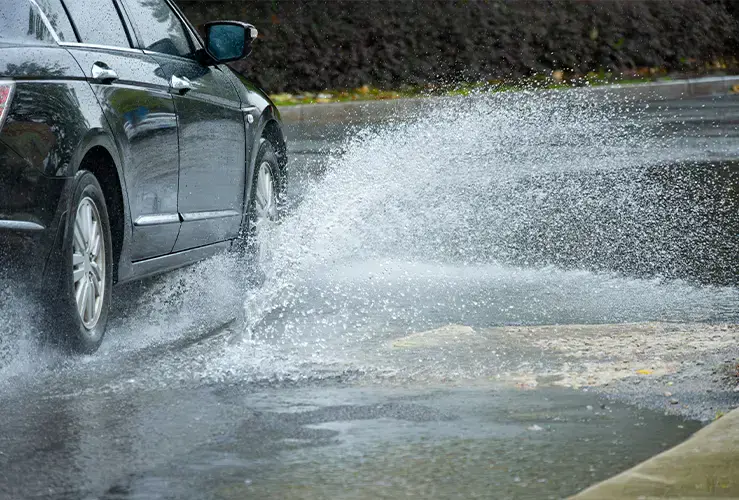
Driving into moving floodwater is even more dangerous than still water. This is because even shallow moving water can create a lot of force - potentially enough to move your vehicle. The government states that just 30cm of fast-moving water can cause a vehicle to float.
How deep is too deep?
There isn’t really a safe depth that applies to every vehicle. It’s likely that an offroad vehicle with lots of ground clearance and four-wheel-drive will be able to handle patches of water better than a small hatchback, for example - but that doesn’t mean it’s ever 100% safe to drive in floodwater in an offroader.
What lies beneath?
All manner of obstacles can lurk beneath floodwater - obstacles that can cause serious auto flood damage, and even cause your vehicle to get stuck.
You might drive into:
- Submerged potholes
- Open drains
- Damaged road surfaces
- Debris
You might even drive into damaged electrical infrastructure.
Engine damage: Even shallow water can be catastrophic
If water gets into your vehicle’s engine, the resulting damage can be extremely expensive to fix. In some cases, the engine may not be repairable at all.
The key thing to be aware of is that any area of floodwater doesn't need to come up to the height of your engine to cause huge damage.
This is because your engine needs oxygen to function - and this oxygen enters through air intakes - which can be positioned fairly close to the ground (often behind the front bumpers/wings).
So by driving through floodwater, water could easily get sucked into your engine, resulting in serious flooded car damage.
Flooding a car’s engine: Hydrolock horrors
Because water doesn’t compress like air does, it can cause a huge amount of pressure inside the engine, potentially causing piston rods to break. This is called hydrolock.
Engine oil contamination
And if water contaminates your car’s engine oil, various moving parts may not be properly lubricated - and fail prematurely.
Electrical component damage
The modern car relies on a huge array of different electrical and electronic components to function properly. If things like wiring, sensors and computer modules get damaged by water, they may malfunction (if not immediately, then later on, once corrosion has taken hold).
Temporary brake failure
Driving in floods can introduce water to your brakes - and stop them from functioning properly. This could of course have disastrous consequences.
My car has stalled in floodwater: What should I do?
If you have driven into floodwater and your engine has stalled, it is critical that you do not try to restart the engine. If you do, you will force more water into the engine, and move from what might be a recoverable situation, to a complete engine destruction.
Car in floodwater: What to do if you’re caught?
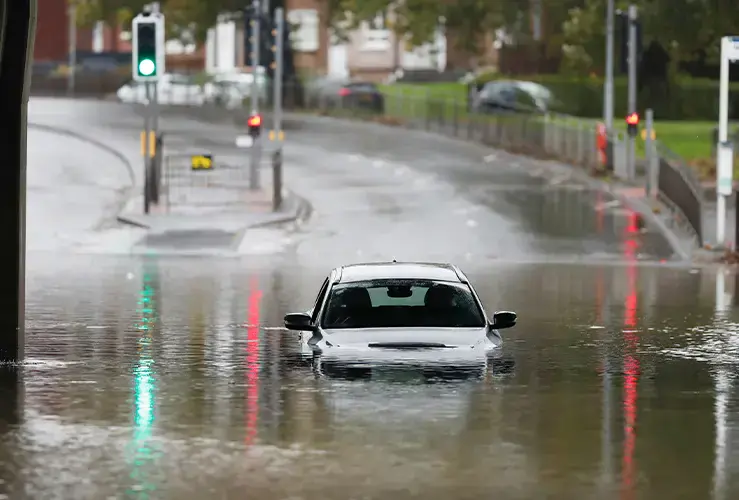
The best course of action will depend on the precise circumstances of your situation - so, for instance, simply ‘staying in your vehicle’ may not always be the best route.
- Stay calm and assess the situation. If the water is rising or moving, the situation can deteriorate quickly. Flash flooding can happen with little warning.
- If you can safely drive to higher ground before the water becomes dangerous, do so. Don't attempt to drive through deeper or fast-moving water simply to escape.
- If the car is already surrounded by water, don't keep driving if the vehicle is losing traction or if the water is rising rapidly.
- If the engine stalls, don't repeatedly try to restart it. Water may have entered the engine through the air intake, and restarting can potentially cause serious damage.
- Unfasten your seatbelt and make sure passengers are ready to leave.
- If it is safe to exit, get out and move to higher ground. Some automotive organisations advise remaining in the vehicle and calling for help if you're trapped, but getting out may be appropriate if the water is still/shallow and there is a safe route to dry land.
- Don't wade through flowing floodwater. You may not be able to judge its depth or current, and there can be hidden drains, debris and damaged road surfaces underneath. GOV.UK specifically advises against walking or driving through floodwater.
- If you cannot safely leave the vehicle, call 999 if you're in immediate danger. Tell the emergency services your location and that you're trapped in a vehicle.
- If you're waiting for rescue, make the vehicle visible. Hazard lights can help rescuers locate you, particularly in poor visibility.
- Don't assume a 4x4 makes you safe. A larger vehicle may cope with more shallow water, but fast-moving water can move vehicles regardless of their size or drivetrain. GOV.UK says around 30 cm of fast-flowing water can be enough to move a car.
Cars in floodwater: Not just a rural problem
Floodwater might be encountered by drivers in various urban settings - not just in rural places like Rufford Ford. City/town roads, underpasses and car parks can flood surprisingly quickly.
How to drive through flood water: Is it ever safe?
If you can avoid driving through flood water, do so. However, if you have no choice but to drive through it, then keep your speed low: Going too fast can create a large bow of water, which can dramatically increase the chances of water entering through your vehicle’s air intakes.
Conclusion
Driving into floodwater can cause serious damage to your vehicle’s engine and electronics. More importantly, however, entering floodwater - especially if it's moving - can put your and your passengers at serious risk.
In short, if you can't be 100% sure how deep an area of water is, do not drive into it; turn around or wait for the water to subside.