


Want to get your hands on a head-turning, conversation-starting import car from Japan, USA, or elsewhere? Doing so could save you money - but there are various taxes and fees to factor in before you click that ‘buy’ button and import a vehicle to the UK.

Image credit: Jan - stock.adobe.com
Fancy getting behind the wheel of a Japanese-market Nissan Skyline GT-R? Or one of those impossibly small Kei-campervans?
Maybe you have something more muscular in mind, such as a vintage US-market 1960s Ford Mustang?
Closer to home, you might be tempted by a classic Porsche 911 from Germany.
You might even have your eye on a classic British car that was manufactured for export, many years ago.
When it comes to importing a vehicle into the UK, there are a multitude of exciting models to choose from - models that you hardly ever see on British roads.
And lower initial purchase prices can be very appealing - but there are other costs to factor in, including shipping, import duty, VAT and a variety of admin fees.
Here we examine if the savings made from the upfront cost - along with the unique specs - are worth the trouble of importing a vehicle from a land far away…
What is an imported car?
A straightforward question on the face of it - but you should know there are different types of imported cars. Here are some of the key ones:
Parallel import: A car that is imported into a country through a company or individual other than the manufacturer's official distributor or dealer network. It would essentially be the same as the version officially sold in the UK, but sourced through an independent importer instead of the manufacturer's official dealer network.
Grey import: This is a vehicle built to another country's specification, meaning it may have different equipment, safety features, emissions standards, or even left-hand drive (for right-lane driving). It also means more tests and paperwork are involved.
Personal import - where a person imports a vehicle they bought or owned overseas, often after living abroad.
Official import: This is your basic dealership model that is imported in large numbers. Much easier to deal with than the other import types listed (no paperwork at all from your side because it’s already in the country).

Image credit: Dmitry Dven - stock.adobe.com
Importing cars to the UK: Why they can be a bargain
Importing a vehicle into the UK can be a lot cheaper than choosing domestic-market equivalents, and can have higher specs and unique features.
And if you want a luxury or performance car, it could offer great savings compared to those locally available (even with the added costs).
Importing also gives you more choice in terms of marques, models and trims - and the chance to own a very unique car that you’re unlikely to see on UK roads.
Common types of imported cars
Parallel imports - those with more or less the same specs as the UK version. They aren’t very unique, but they can be cheap. These are among the most popular types of car imported to the UK.
Then comes Japanese Domestic Market (JDM) cars - there are cars built for the Japanese market, and so are regarded as grey imports. Japanese import cars are very popular among some UK car enthusiasts. If you’re after a rare model like the Nissan Skyline GT-R, the MK 4 Toyota Supra, or the rally-inspired Subaru Impreza WRX STI, then a JDM import is your best bet.
Because Japanese cars are not built to UK/European standards, there is more paperwork involved (more on this later).
However, Japanese imports are Right Hand Drive (same as the UK) - which is an obvious advantage, and strict Japanese anti-corrosion rules mean your purchase is unlikely to be rusty (critically, the Japanese don’t use corrosive salts on roads during winter).
US imports are also popular, particularly the muscle-car category (think Mustang, V8 Dodge Challengers, and Chevrolet Corvettes). Paperwork is about the same as with Japanese cars.
European imports, meanwhile, are easier (and quicker) to sort out - due to regulatory alignment when the UK was in the European Union. Aside from European classics like the Porsche 911, some enthusiasts seek UK-built cars like the Jaguar E-Type, which were exported decades ago to non-UK spec.

The hidden costs buyers often overlook
But - nothing good is easy.
Choosing to import a vehicle to the UK comes with costs: higher insurance premiums; shipping, VAT and import costs; registration and compliance fees, and vehicle modifications if the car doesn’t meet UK standards. And of course, foreign exchange movements add another layer of uncertainty, which on a car costing £10,000, might not be negligible.
Here’s a rundown of the main costs you’ll need to budget for (not every car will attract every cost):
Importing cars to the UK - at-a-glance
Cost | What it is | When it applies | Typical cost |
Purchase price | Price paid for the vehicle | Always | Varies |
Shipping/freight | Sea freight, air freight, or RoRo transport | Most imports | £500 - £3,000+ |
Marine insurance | Covers the vehicle during transit | Optional but recommended | ~1–2% of vehicle value |
Port handling fees | Charges for unloading and processing at the UK port | Usually | £100–£500 |
Customs clearance/broker fee | Fee for handling import paperwork | Usually | £50–£250 |
Import duty | Customs duty on imported vehicles | Usually applies unless an exemption or preferential tariff applies | Typically 10% of customs value* |
VAT | Value Added Tax | Most imports | Usually 20% (calculated on the customs value plus duty and certain other costs) |
NOVA declaration | Notification of Vehicle Arrivals submitted to HMRC | Required for most vehicles brought permanently into the UK | Usually free if you submit it yourself; agents may charge £50–£150 |
IVA test | Individual Vehicle Approval inspection | Required for some imported vehicles without acceptable type approval | Approximately £200–£500 depending on vehicle category |
MSVA test | Motorcycle Single Vehicle Approval | Motorcycles only | Varies |
Vehicle modifications | Changes needed to meet UK standards (lights, speedometer, fog light, etc.) | Only if required | £100–£2,000+ |
MOT test | Roadworthiness test | Required if applicable due to vehicle age or registration circumstances | Around £55 (maximum test fee for a standard car) |
Vehicle Identity Check/inspection | Additional inspection if requested by authorities | Occasionally | Varies |
DVLA first registration fee | Fee to register the vehicle in the UK | Usually | £55 |
Vehicle Excise Duty (Road Tax) | Tax due when the vehicle is first registered | Usually | Depends on CO₂ emissions, fuel type, age and value |
Number plates | UK registration plates | On first registration | £20–£40 |
Insurance | Required before driving on UK roads | Always | Varies widely |
Storage/demurrage | Charges if the vehicle remains at the port too long | Only if delayed | £20–£100+ per day |
Transport within the UK | Delivery from the port to your home or garage | Optional | £100 - £600 |
Your imported car may also need an MPH overlay for the odometer if it displays KM/H - and if it is aged 10 years or less.
Servicing and maintenance challenges
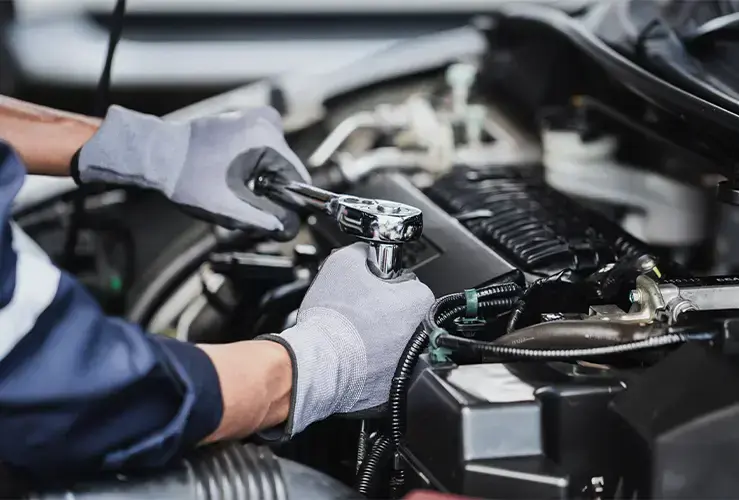
Keeping your imported car in tip-top condition could also be a challenge over time. It won’t be easy (or cheap) to source spare parts, so repair times could be longer. You’ll also need to find garages with knowledge of your model, and they’ll likely charge more than for a UK-market car. Additionally, there can be compatibility issues with diagnostic equipment.
Reliability and vehicle history concerns
There can also be reliability and vehicle history hiccups, especially for non-European market models. You may have to deal with incomplete or unverifiable service records, mileage discrepancies, and previous accident or flood damage.
Maintenance standards may also differ between countries.
With these issues in mind, it’s a good idea to get an independent inspection down before you seal the deal.
Insurance and warranty considerations
Getting your car insured could also be problematic - not all insurers will cover an import, especially if it has unique features/spec. And because parts may be scarce, you’ll likely need to stump up more for coverage.
Another issue is that the manufacturer warranty may not transfer internationally - so you’ll need a third party, aftermarket policy.
Resale value
If you decide to sell your import, you’ll probably have a small pool of buyers - and they’ll be concerned about getting parts and servicing, just as you would have been. However, models with strong enthusiast demand may retain value well - but understand the importance of documentation when selling.
Legal and regulatory issues
You’ll also need to think about emissions compliance and safety standards - and that they meet UK regulations where required.
As mentioned in the table above, there’ll be registration requirements and MOT/roadworthiness implications. You’ll need specific documentation for ownership and importation, such as the NOVA declaration and the IVA test.
When does buying an imported car make sense?
If you’re an enthusiast/collector looking for a rare or higher spec model, importing a car to the UK could make sense (and may be your only option).
If you already know where you can get your desired model serviced, that can be a big plus.
Needless to say, you should thoroughly research any prospective purchase before you part with your money.
When is it better to buy a domestic model?
But if you’re a regular commuter for whom reliability is a priority, then you might be better off with a domestic model; you’ll be able to get it serviced and find spares easily - and more cheaply.
If you want rock-solid warranty support, or think you’ll want to sell within a few years, a UK mass-market car would be a more sensible option.
Buying checklist
Here’s a handy list of to-dos when importing a car to the UK:
- Verify import documentation.
- Check vehicle history.
- Confirm parts availability.
- Obtain insurance quotes before purchase.
- Arrange a professional pre-purchase inspection.
- Confirm servicing options locally.
- Check warranty eligibility.
- Compare the total ownership cost - not just the purchase price.
So, should you import a car to the UK?
Imported cars can offer excellent value when purchased carefully - and may allow you to get behind the wheel of a unique or higher spec vehicle.
However, you should be aware of the various costs, and of time delays both at the original country, in ports and during shipping - and once it has arrived in UK ports and will be scrutinised by HM Revenue and Customs (HMRC).
If you want to buy an imported car, you should balance any initial savings against maintenance, insurance, servicing, and resale considerations before making a final decision.