



The average weight of a car has increased substantially in recent years - equivalent to an extra passenger compared to two decades ago. The modern car now carries more metal, more equipment and, increasingly, more battery. Learn what this means for your tyres, running costs - and for the overall safety of the road system.
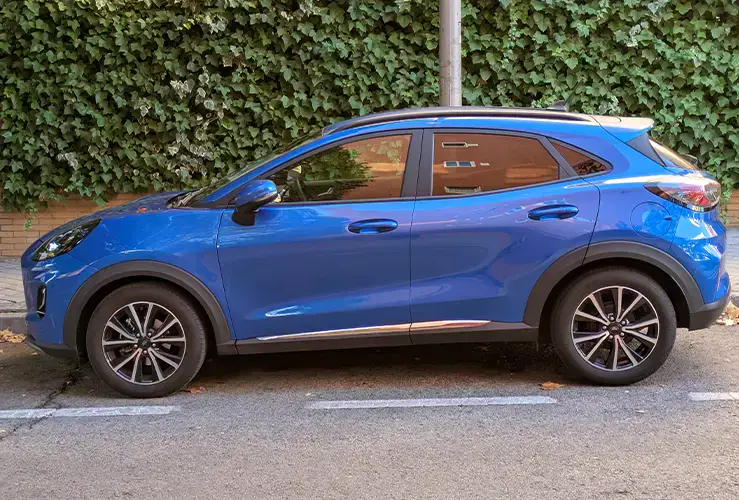
Image credit: teracreonte - stock.adobe.com
The gross weight of vehicles has increased substantially over the last 20 years, as has their height.
Partly because of this, they are safer than ever before.
A case in point is the UK’s top selling models over the last two decades. In 2006, it was the Ford Focus. Today, it is the Ford Puma. Put them both on the scales and the difference is roughly equivalent to an extra adult.
Generally speaking, that additional mass means the occupants are now safer - but it also means there’s a lot more mass to dissipate on impact, resulting in more force being inflicted on whatever (or potentially, whoever) it hits.
So while heavy modern cars may be safer for their occupants, they could be bad news for lighter vehicles or pedestrians they collide with.
This has led to a peculiar kind of arms race: to build vehicles that are heavier and taller. Ironically, if this is the aim of most carmakers, then the benefit of being in a heavier vehicle is reduced or eliminated - since most other vehicles are similarly heavy.
The average mass of a car has increased by 19%
The average increase in car weight is even more dramatic than the above Ford Focus/Puma comparison. According to the International Council on Clean Transportation (ICCT), the average EU car has increased from 1,276 kg in 2001 to 1,518 kg in 2022 - that’s an increase of nearly 20%.
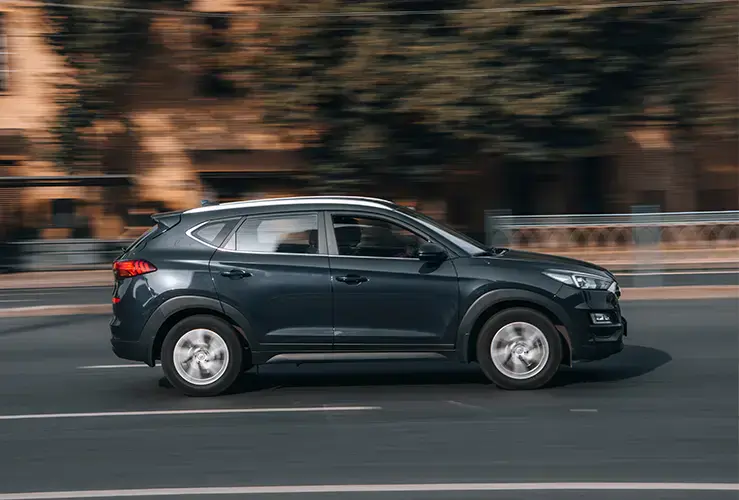
Image credit: vector_master - stock.adobe.com
How much does my car weigh?
Wondering how much your car weighs? Here’s the weights of vehicles commonly sold in the UK in 2026.
Popular UK car | Body type | Representative kerb weight |
Ford Puma | Small SUV/crossover | ~1,280 kg |
Kia Sportage | Family SUV | ~1,665 kg |
Nissan Qashqai | Family SUV | ~1,500–1,700 kg |
Vauxhall Corsa | Small hatchback | ~1,055–1,300 kg |
Volkswagen Golf | Family hatchback | ~1,300–1,600 kg |
Nissan Juke | Small SUV/crossover | ~1,230–1,355 kg |
Volkswagen Tiguan | Family SUV | ~1,500–1,700 kg |
Hyundai Tucson | Family SUV | ~1,500–1,800 kg |
What makes modern cars heavier
But “just being heavy” isn’t the only goal; vehicles have gotten heavier because they now contain all manner of components that cars of 20 years ago just didn’t have.
And many of these additions have themselves made cars - and the roads in general - safer.
In the case of electric vehicles, the weight gain has become even more dramatic - since EV batteries are so heavy.
Here’s what has made cars so much heavier over the last 20 years.
1. Bigger bodies
Cars have become longer, wider and taller, particularly because buyers have shifted from hatchbacks and saloons towards SUVs and crossovers.
A recent analysis found that new cars in Europe and the UK have been growing by roughly 1 cm wider every two years, while research into "carspreading" found average new-car length increasing by about 1.2 cm per year since 2000.
More bodywork means more steel/aluminium, glass, interior trim, sound insulation, and structural reinforcement.
So there's a feedback loop: a bigger car creates room for more equipment, which makes it heavier, which requires bigger components to move and stop it.
2. Crash structures and passive safety
This is one of the more legitimate and understandable reasons for weight increases.
Modern cars have larger and more sophisticated crumple zones, stronger passenger cells, reinforced doors and pillars, stronger seats and head restraints - and much else besides.
The objective hasn’t simply been to make the car "stronger" - it's been to control how the car deforms, and how rapidly occupants decelerate.
Ultimately, modern safety standards and increasingly demanding crash tests have pushed manufacturers towards more elaborate (and therefore heavier) structures.
3. Active safety and driver assistance
The modern car has acquired an entire second layer of safety hardware.
These systems include ABS, electronic stability control, autonomous emergency braking, radar, cameras - and much else besides.
Taken alone, many of these components aren't particularly heavy. Together, however, sensors, computers, wiring, actuators and associated hardware all add up.
Some of the weight has been added not to make crashes survivable, but to prevent collisions from happening in the first place.
4. More airbags and restraint technology
The average 2006 car already had airbags, ABS, and sophisticated restraints, but modern cars often have considerably more elaborate restraint systems.
These systems include side airbags, curtain airbags, knee airbags, seat-mounted airbags, and pyrotechnic seatbelt pretensioners.
While these add weight and complexity, they're a relatively small contributor compared with the body, battery and powertrain.
5. Comfort and luxury equipment
This "invisible" weight is something you might not think about too much. Cars have accumulated a lot of equipment that simply wasn't standard on a family car 20 years ago.
We’re talking larger and heavier seats, electric seat adjustment, heated and ventilated seats, larger climate-control systems, larger audio systems, navigation/infotainment systems - among many other components designed to make driving more pleasant and comfortable.
Customers demand more equipment, while thicker glass, sophisticated climate systems, electric seats, bigger wheels and other equipment all add mass.
So while some of the weight in a modern car is there to save your life - some of it is there simply to heat your seat.
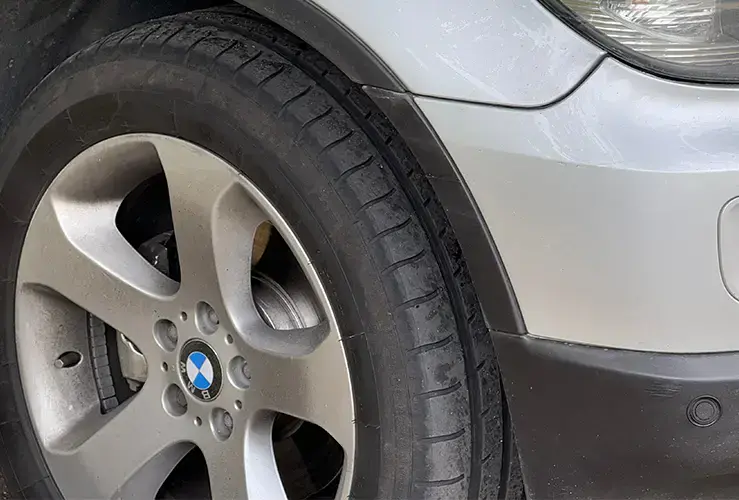
Image credit: belavinstock - stock.adobe.com
6. Wheels and tyres
Wheels too have gotten much bigger.
A typical family car that once wore 15- or 16-inch wheels might now have 18-, 19- or even 20-inch wheels.
That means larger wheels, larger tyres, bigger brakes, and heavier suspension components.
7. Electrification - the big new contributor
This is arguably the most important recent source of additional weight.
An EV replaces a relatively light fuel tank and engine system with a large battery pack.
And batteries are heavy.
That's why EVs tend to be heavier than otherwise comparable petrol/diesel cars, although the UK Government points out that the overall increase in vehicle weight predates electrification, and that some conventional cars are now as heavy as EVs.
8. SUVs and the "arms race"
There’s been a noticeable shift from small hatchback to large hatchback to crossover to SUV, fundamentally changing what we consider a "normal" car.
SUVs tend to be taller, wider, longer, heavier, fitted with larger wheels, and equipped with more powerful engines. They are also, increasingly, electrified.
And consumer preferences reinforce the trend. Recent analysis of European cars identifies the increasing popularity of SUVs alongside electrification as major drivers of rising weight.
This is where the safety arms race comes in. Because if you're worried about being hit by a large, heavy vehicle, you have an incentive to buy a large, heavy vehicle yourself.
Do the weights of vehicles influence running costs and maintenance?
Yes, heavier vehicles have increased some running and maintenance costs.
Most notably, tyres wear out faster due to the higher weight. And because they tend to be bigger than years ago they cost more to replace.
Heavier cars also put more strain on the brakes and suspension components.
Additionally, heavier cars generally need more energy, especially with start-stop urban driving. However, regenerative braking means that some kinetic energy can be recovered when slowing down.
Conclusion
The modern car is heavier partly because today’s motorists want more safety equipment, comfort and technology. But that extra mass then requires bigger brakes, bigger suspension, bigger tyres, more energy, more expensive components.
Looking to the future, the challenge will be to make cars safer for both occupants and other road users, without making them heavier.