


Getting a modern vehicle repaired often requires technicians to access proprietary/restricted car diagnostic software and repair programs, which can mean less choice and control for motorists. In the future, it might also lead to higher costs.
In decades past, you didn’t have to be a rocket scientist to understand how your car worked. Today, however, it can feel like you do indeed require the brains of a genius to work out why your vehicle won’t start.
Here we take a deep dive into repairability and software-locked vehicles, and ask: Who’s really in control of your vehicle?
More than just four wheels and an engine…
Modern cars are no longer simply a way to get from A to B- they are computers on wheels.
From engine management to safety systems - and even heated seats - much of your vehicle’s functionality is now controlled by software (unless you happen to own a Morris Minor). Undeniably, this has made cars more efficient, safer, and easier to diagnose, but it has also given us a new challenge: repairability.
Central to this issue is the increasing reliance on car diagnostic software, along with the rise of so-called “software-locked” vehicles. For us as drivers, and for garages and the wider automotive industry, this notable shift is changing what it means to own and repair a car.
What is car diagnostic software?
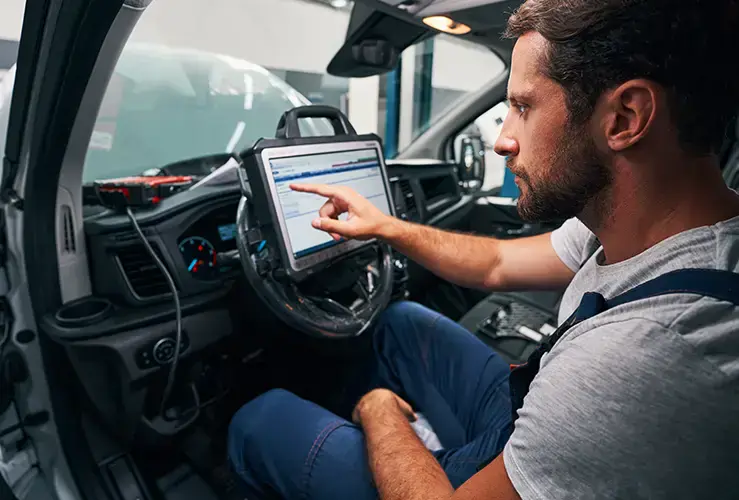
Car diagnostic software is a term used to describe programs that talk to your vehicle’s critical onboard systems. These tools empower mechanics, and sometimes you as a driver, to read fault codes, keep an eye on performance, reset warning lights, and critically, carry out repairs.
Years ago, diagnosing a problem might involve tinkering under the bonnet, and physically inspecting parts. Today, however, technicians plug into a car’s onboard computer and use automotive diagnostic programs to pinpoint issues, often in mere minutes. These systems can pinpoint faults in everything from the engine and transmission, to advanced driver assistance systems (ADAS).
There are a bewildering array of different types of automobile diagnostic software available. These range from basic consumer apps to advanced platforms designed and deployed by dealerships.
Some of these are created for independent garages, while others are proprietary tools developed by manufacturers and restricted to authorised service centres.
But love them or loathe them, as vehicles become more complex, software for car diagnostic purposes has become essential for keeping your car on the road - not optional.
The existence, and need, of these tools can make you wonder: How much control over my vehicle do I actually have?
What are software-locked cars?
A “software-locked” car is one where particular functions, repairs, or features are controlled or restricted by the manufacturer through a variety of digital systems. Sometimes, even if the physical hardware exists in the car, it cannot be accessed without software activation.
For example, some manufacturers have (somewhat controversially) experimented with subscription-based features, where drivers pay monthly fees to unlock certain functions like heated seats, or advanced driving modes. BMW drew criticism for trialling just this approach in several markets.
Such actions can make drivers feel like you’re not allowed to access your car’s features without stumping up yet more money.
Other companies, such as Tesla have taken software control even further. Tesla vehicles like the Model Y can receive over-the-air updates that alter how the car behaves. Such updates can even limit features or even restrict repairs, unless carried out through approved channels.
What does this mean in real-world terms?
- Getting certain repairs done requires manufacturer authorisation
- Fitting some replacement parts can need software pairing to work
- Independent garages can get locked out of essential systems
This expanding level of control is transforming the car repair landscape and many might argue in ways that don’t always benefit motorists.
Software-locked cars: The impact on drivers
For everyday motorists, the rise of software-locked cars can have various consequences.
Repairs will get more expensive
When access to certain systems gets restricted, the only option for drivers is to return to main dealerships to get repairs done. Often, these services are more costly than going to a local independent garage. This is particularly the case when specialist auto repair software or licences are needed to proceed.
Less choice for motorists
In the past, drivers could choose from a wide range of local garages. Now, some repairs can only be completed by authorised technicians with access to manufacturer-approved automotive repair software.
You can’t do as many “DIY” fixes
Car enthusiasts and DIY mechanics are increasingly frustrated to find it more difficult to work on their own vehicles. Even what should be a quick, simple fix can require a software reset or some kind of digital authorisation. Sadly, this can make traditional hands-on repair skills less applicable.
More delays, more inconvenience
If only certain locations can carry out specific repairs, drivers may have to wait longer to get their vehicle back on the road. Additionally, they may have to travel further to get their car fixed. This is comparable to when banks or health services close local access points and consolidate them elsewhere.
Your independent local garages are losing out
The big losers in this shift are arguably independent garages. Many of these garages rely on third-party auto repair software in order to service vehicles (particularly more modern, advanced ones), but access to these is becoming more restricted, not to mention expensive.
To stay in business, garages must pour money into:
- Licensed software automotive repair platforms
- Ongoing/regular updates and subscriptions
- Manufacturer-specific tools and training
Even when they do all this, they may not have full and complete access to all vehicle systems. In some cases, critical functions, like recalibrating sensors or coding new parts, are locked behind manufacturer-only systems.
Clearly, this establishes an uneven playing field, where smaller, local garages struggle to compete with big-name, franchised dealerships. In the long term, this may well reduce competition, which will only lead to higher repair costs for UK motorists.
The right to repair debate rages on
Software-locked cars is an issue that chimes with the broader “right to repair” movement, which has gained so much momentum in recent years. This campaign argues that consumers should have the legal right to repair and modify the products they have purchased with their hard-earned cash, including vehicles.
Right to repair supporters argue that:
- Drivers should be able to access to the same diagnostic tools as carmakers
- Independent garages should not be locked out of being able to offer repairs
- Repair information should be transparent and available to all
In response to these concerns, regulators in the European Union and elsewhere have begun looking into possible legislation that could improve repair access.
Carmakers tend to respond negatively to such moves. They highlight worries around safety, cybersecurity, and of course, intellectual property. They argue that unrestricted access to vehicle systems could increase the risk of tampering, or other sorts of misuse.
At present the tug-of-war between control and access rages on.
Are there any benefits to having software restrictions?
Understandably, many car owners and independent garages dislike this level of control, but software restrictions are not without their advantages.
Highers levels of safety
There's no denying it: modern vehicles rely on complex systems which must be calibrated very precisely in order to work. By restricting access, carmakers help ensure that repairs are carried out correctly, thereby reducing the risk of faulty fixes. For example, an incorrectly calibrated automatic emergency braking (AEB) system could result in a car making an emergency stop when there is no obstacle present.
Better levels of vehicle security
Software locks can help prevent vehicle theft or unauthorised modifications. A good example of this is requiring digital authentication for new parts; this can make it harder to use stolen components (good for honest motorists, bad for criminals).
Faster updates and fixes
Over-the-air (OTA) updates allow manufacturers to fix issues without requiring a garage visit which is undeniably good for drivers. In some cases, problems can be resolved remotely, saving time and inconvenience.
Advanced diagnostics
High-quality car diagnostic software can identify issues more accurately than traditional methods. This should, in theory, lead to quicker and more efficient repairs (costing drivers less).
These benefits are central to why manufacturers don’t want to fully open their systems even as more and more drivers and technicians clamour for change.
What does the future look like?
Greater digitalisation within the car industry seems inevitable. As electric vehicles, connected systems, and autonomous features become increasingly common, software including automotive repair programs, will play an even larger role in how cars work - and of course, how they are repaired.
Key questions for the future:
- Will motorists continue to accept restricted access in exchange for convenience?
- Can independent garages adapt to increasingly complex systems, and will they be allowed to?
- Will governments/EU step in to obtain fairer access to repair tools and data?
The answers to these questions will directly impact the cost of owning and running a car but they could also decisively influence the battle between carmakers and motorists like you.
Conclusion
How repairable a car is no longer depends on tools and mechanical skill, it is about access to critical software and tools. As vehicles become increasingly advanced, control over automotive diagnostic programs and repair systems is becoming an important battleground in a world where corporations have more and more influence over our lives.
For you as a driver, this means navigating a landscape where owning a car does not always guarantee the ability to repair it freely and without the approval of a carmaker. Technology certainly brings benefits in terms of performance and safety, but it also raises serious questions about the resultant limitations.
In the end, the prevalence of software-locked cars raises a key question that at present has no solid answer: if you cannot fully repair your vehicle, do you truly own it?